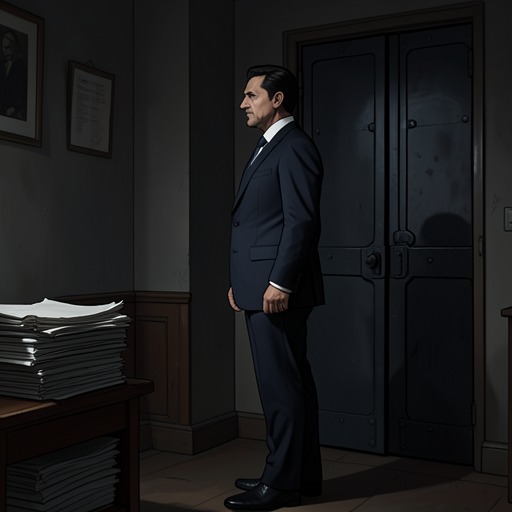
“A defence lawyer defends his client, no more and no less.”
The Collini Case“A defence lawyer defends his client, no more and no less.” The maxim, spoken by Mattinger, becomes a measure of the distance between the clean limits of professional duty and Leinen’s unsettled response to the case. Its return in his thoughts does not resolve that tension; it makes clear that the rule is easier to state than to live by.
Wording and Attribution
Mattinger offers the sentence as something meant to help. Its balanced phrasing draws a firm boundary around the lawyer’s role: the client is the object of the defense, and everything beyond that is excluded. Leinen remembers the exact words later, alone in his apartment, giving the maxim the force of an answer he has tried to use.
Leinen’s Response
The advice does not work. After opening the window and lying down, Leinen recalls the sentence and recognizes that it has failed to ease him. His thoughts move instead to Johanna and to the trial of Fabrizio Collini, which, he knows, will not really begin until the following day. The sequence places the maxim beside the personal and legal pressures it cannot contain.
Narrative Significance
The expression frames a conflict between the formal limits of defense work and Leinen’s continuing emotional involvement. The narration neither rejects Mattinger’s principle nor presents it as sufficient comfort. Instead, its recurrence in Leinen’s private thoughts shows the gap between knowing the professional rule and finding that the rule can quiet what the case has stirred.